
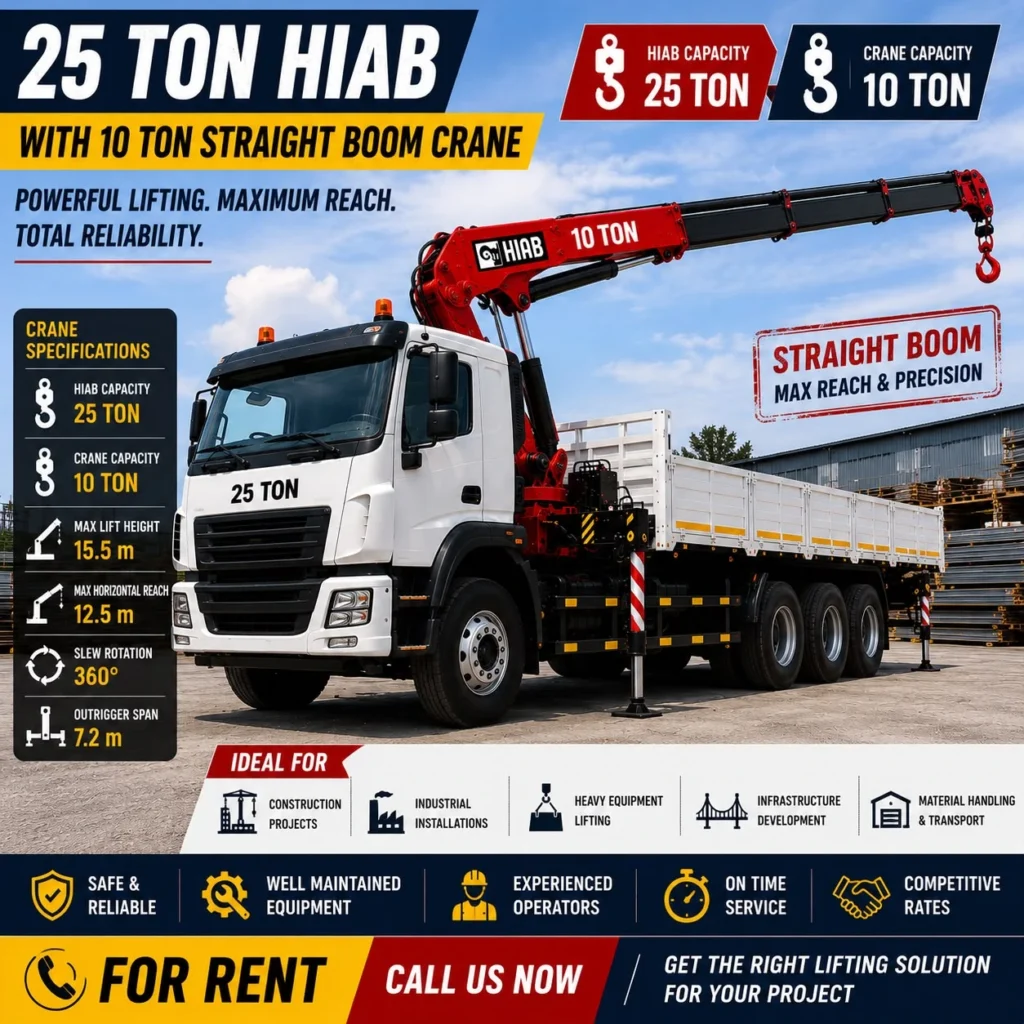
A Hiab truck fitted with a 10 ton straight boom crane is a specialist transport machine designed for heavy lifts, as the 25 ton GVW (gross vehicle weight) flatbed truck has the capacity to carry up to 10 ton of load.
A straight boom crane moves in one straight line, either telescoping outwards or at a fixed angle, as opposed to a knuckle-boom (articulated) crane which folds at a central pivot point. This design offers enhanced vertical lift performance, increased stability on long reaches and can lift above obstructions that a knuckle-boom cannot reach. The straight boom configuration is often the only solution for jobs where loads need to be lifted above a building parapet, above a wall or fence line or lowered into a deep pit from a distance.
The 25 ton + 10 ton straight boom combination is exceptionally popular in the construction, oil & gas, manufacturing, utilities, and logistics industries for situations where heavy loads must be both transported and placed with precision, often at great height or reach.
It’s important to know the difference between these two crane types to ensure you are using the right machinery for your project.
Straight Boom (Telescopic) Crane:
The boom is straight and is either inclined upward or is horizontal. Can achieve heights much higher than a knuckle boom and offers a more consistent lift geometry when a load must be placed directly overhead or at extreme outreach. It works well for lifts greater than rooflines, over structures or loads that need to be lifted vertically during operation.
Knuckle Boom (Articulated) Crane:
The boom features a pivoting joint in the middle that enables it to unfold and fold for easier loading and unloading in tight spaces. It can be used for cargo handling in general applications, and can be used in tighter spaces than a comparable straight boom unit; however, it has lower maximum lift height and pure vertical reach.
The straight boom configuration is a good option when the two booms are positioned along a single line.
Specification | Detail |
Vehicle Type | Heavy-duty flatbed with straight boom (telescopic) crane |
Gross Vehicle Weight (GVW) | 25,000 kg (25 tonnes) |
Crane Lifting Capacity | Up to 10,000 kg (10 tonnes) at minimum outreach |
Crane Type | Straight telescopic boom — single-line extension |
Maximum Vertical Hook Height | Up to 18–20 metres (model dependent) |
Maximum Crane Outreach | Up to 15–16 metres (model dependent) |
Boom Sections | 3–4 telescopic sections |
Slewing Range | 360° full rotation |
Stabiliser Outriggers | 4-point hydraulic outriggers (front and rear) |
Deck Length | Approx. 6–7 metres |
Net Payload Capacity | Approx. Target Customercrane operators, licensed and certified in accordance with standards of the International Marine and Coastal Safety Association (IMcSA), who are operating under the radio control of an operator who is also licensed and certified as a crane operator under IMcSA standards. |
There are several reasons why hiring a 25 ton hiab crane with a straight boom is advantageous.
Greater Vertical Reach.
The straight boom design provides a much higher lift height than a knuckle boom of the same rating. The straight boom crane has vertical hook heights of up to 18–20 metres on certain models, allowing the crane to reach rooftops of multi-storey buildings and position loads well above the standard heights of buildings without the need of an additional mobile crane being brought on-site.
Superior Stability on Long Reaches.
The boom is a single straight line boom and not an articulated boom so that this maintains the load path more predictable and the geometry of the boom also provides a better mechanical advantage at extended boom lengths. This enhances the controlled and stable lifting – especially for heavy or awkwardly shaped loads.
Over-Obstacle Lifting.
In urban areas many jobsites have loads to be lifted over walls and fences, scaffolding structures, or adjacent property lines. The straight boom crane can achieve the vertical clearance performance, so when the height of the load is higher than the working space, it is suitable to be used.
Reduced Need for Additional Equipment.
By using the vehicle payload capacity, the need of a separate mobile crane to site is eliminated in many projects, resulting in a reduction in overall project lifting costs, permit requirements and site space consumption.
Precision Load Placement.
Mechanical/ electrical equipment installation, precast concrete placing and any application that demands precise alignment of loads can be made with the single-axis boom extension with 360° slewing.