
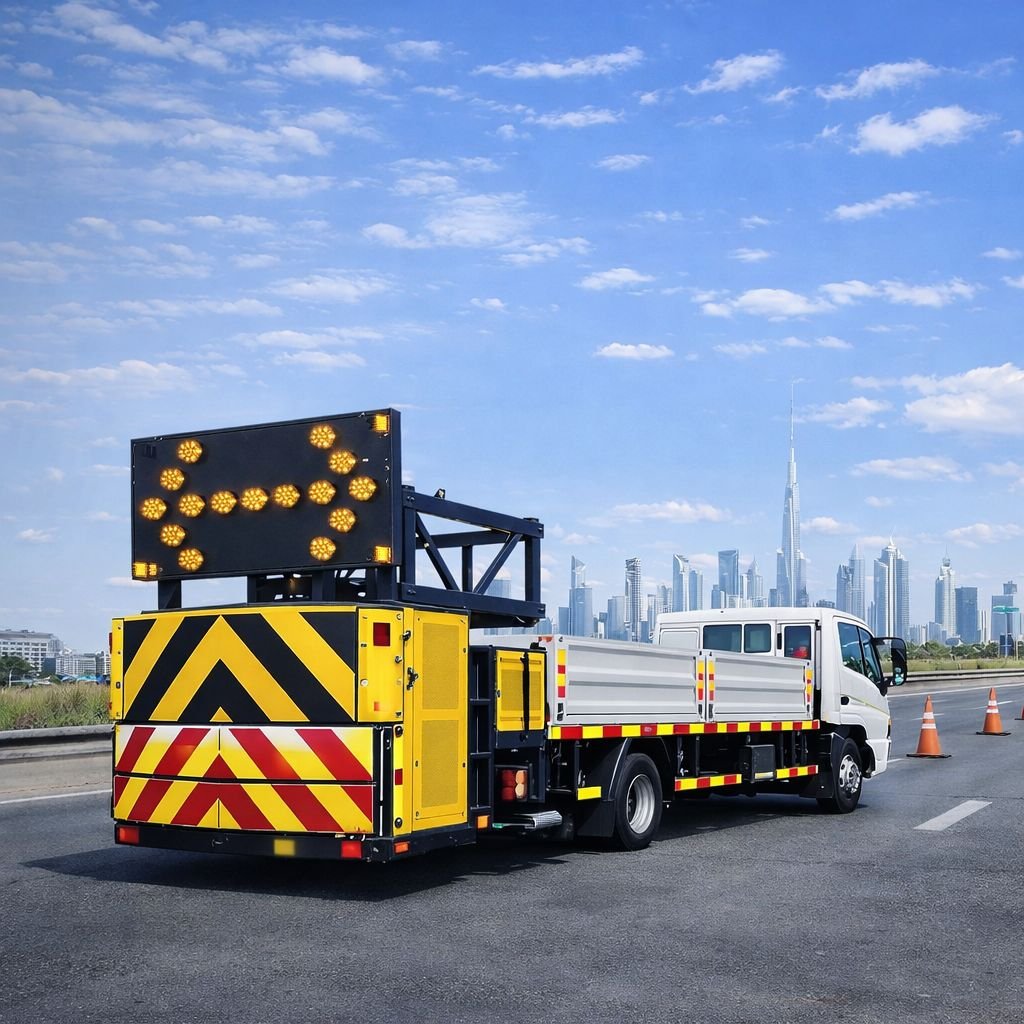
The Truck Mounted Attenuator, more commonly known as a TMA, is a crash impact absorption device mounted on the rear of a shadow vehicle and installed ahead of a road construction or maintenance project. It is chiefly used to absorb the kinetic energy of an errant vehicle that is unable to maneuver away from the work zone so as to not have the potential to enter the work zone and impact road workers and stationary equipment.
A TMA is not a piece of optional equipment on any construction site for which live traffic is involved, whether it be a full carriageway closure, lane restriction, utility trench excavation alongside a live road or a maintenance operation on a bridge. Safety is a basic need in all road traffic safety systems as per UAE Road Safety Regulations, Dubai Road Authority Work Zone Standards and International Traffic Management Best Practice.
The impact of an unprotected work zone can be devastating in Dubai in particular: traffic is heavy, road speeds are often 80-120 kmph on major arterials and highways. A correctly installed TMA is able to absorb impact forces which would otherwise be passed directly through to workers, supervisors and equipment — and in many instances, the TMA is the only barrier between a normal construction phase and death.
A TMA unit is installed in a heavy shadow vehicle (usually a truck or flatbed lorry), which is either at the back of the work zone convoy or parked at the upstream side of the lane closure. The attenuator is a series of carefully engineered “crash cushion” cells constructed from high strength aluminium, steel or composite materials designed to gradually crush upon impact, absorbing the kinetic energy of a vehicle crashing onto the attenuator, but not the same crash impact forces.
At high speeds, the car collides with the TMA and the attenuator takes the impact’s energy and slows the car down in a controlled manner, while at the same time pushing the car away from the work area. The principle of the shadow vehicle is to have it move forward on impact and absorb residual energy, while the TMA structure absorbs the bulk of the impact of the collision.
The TMA unit is evaluated after a major impact and those areas of the cartridge or cushion cells that are damaged are replaced prior to return to service. An important part of its design is that it’s replaceable, but not the people who built it.
TMA units are classified into speed zones based on how they are used in work zones, as defined by UAE work zone safety requirements and international standards. The selection of the appropriate TMA classification for a particular road environment is a compliance requirement, and not an option.
TL1 — Test Level 1
For low speed use of up to 50km/h. Applicable in construction sites on residential streets, parking areas, service roads and low speed urban areas where traffic speeds are physically controlled. TL1 is the lightest and smallest classification of TMA.
TL2 — Test Level 2
Medium speed up to 70 km/h. Can be used on urban arterial roads, collector roads and construction areas where the speed limit is 60-70 km/h. Most construction sites in Dubai and during road maintenance operations are classified under TL2.
TL3 — Test Level 3
High speed (100 kmph and above). Sheikh Zayed Road, Emirates Road, Al Khail Road and all construction and maintenance activities on roads having speed limits of 80 km/h or more in Dubai. TL3 is the highest, heaviest and most impact-resistant TMA classification available.
The installation of a TL1 unit on a high-speed highway is a major safety and regulatory issue. We will always check the appropriate TMA classification for your site before deployment — making sure it is fully compliant and therefore providing maximum protection.
Certain construction activities require a TMA.
Road Construction and Widening
For new road works and carriageway widening projects, TMA needs to be maintained throughout the construction work, especially when workers and plant are in contact with traffic during the excavation, subbase and asphalt laying and kerb installation works.
Bridge and Flyover Construction
Working over or next to a live traffic lane is a common requirement in the construction and maintenance of bridges. Installing TMA on approach roads and under bridge structures is imperative to keep the workers at height and supervisory ground personnel safe.
Utility and Service Trench Works
Trench excavation and covering for water, drainage, telecommunications, power and district cooling services that come across or alongside live roads must be covered for the entire duration of the open trench phase. TMA rental for utility contractors is amongst the busiest of all the categories in Dubai, as there are numerous utility upgrade projects going on at any particular time.
Asphalt Resurfacing and Pavement Works
Slow moving machinery such as milling machines, paving trains and roller compactors generate long work zones on live roads for resurfacing and patching operations. TMA shadow vehicles accompany the paving convoy throughout the entire paving operation to provide protection of the moving convoy.
Installing concrete barriers and safety infrastructure.
Workers need to be placed in close proximity to high speed traffic to install the NJ barriers, water-filled barriers, and permanent safety hardware on live roads. TMA protection is essential during these operations.
Traffic Signal and Street Lighting Works
Electrical contractors working when there are a live carriageway alongside traffic signals, street lighting columns and overhead gantries must be covered by TMA during the actual installation and cable pulling process.
Waterworks and landscaping.
The use of TMA is required for roadside landscaping, irrigation pipe installation and tree planting operations along major boulevards and highway verges in Dubai where workers are in the clear zone of live traffic.
Emergency Road Repairs
Rapid deployment of TMA is often needed to complete pothole repair, emergency utility reinstating or unplanned road defect repairs, which are often conducted at short notice at night times and on weekends. We have an emergency hire service available 24 hours a day so you will always be protected when an urgent repair can’t wait.
A set of road safety and work zone regulations, which work together, require the use of TMA on any road construction site in Dubai. The above regulatory references are some of the key regulatory references:
Practical matters to consider for the RTA Dubai Work Zone Safety Requirements.
The Roads and Transport Authority (RTA) in Dubai has established its standards for traffic management, works zone protection and impact attenuators on all works of interest on public roads. The TMA deployment is specifically required for lane closures and applies to roads with speeds above certain levels.
Construction Site Safety Standards (CSS) in Dubai Municipality.
Construction Site Safety Standards (CSS) in Dubai Municipality.
Dubai Municipality mandates any contractors carrying out works near live roads to provide an approved traffic management plan with sufficient impact protection measures such as the deployment of TMA wherever necessary and appropriate based on the speed environment.
Trakhees Regulations
For onshore construction projects in Dubai’s free zones and port zones, such as Jebel Ali and Port Rashid, the regulatory arm of DP World (Trakhees) sets its own work zone safety standards that are consistent and in some cases, more stringent than the standards set by RTA.
ADNOC and Industrial Zone Requirements
Construction and maintenance activities in the ADNOC facilities and industrial zones and energy infrastructure sites are subject to specific HSE requirements for use of TMA on activities carried out next to roads in the Dubai region (UAE).
Failure to follow Dubai requirements for work zone TMA can lead to stop work orders, monetary fines, contractor blacklisting and, most importantly, loss of life that is the goal of TMA implementation.